
BECKETT’S INFLUENCES
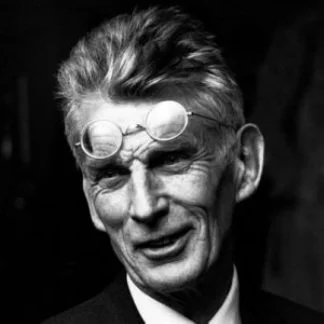
Samuel Beckett was a passionate lover of art and a friend of many painters and sculptors. He loved Dutch and Flemish painting in particular – and art almost certainly inspired some of his most memorable theatrical images. Even his earliest plays, such as Waiting for Godot or Endgame, recall the old masters: the character Lucky in Godot may well remind you of a Brueghel grotesque; Estragon and Vladimir's physical antics echo scenes in Adriaen Brouwer's paintings ("Dear, dear Brouwer", Beckett called him); Hamm in Endgame appears to share genes with some portraits by Rembrandt, staring out at the viewer – Jacob Trip in his armchair, perhaps.
As for Beckett's late miniature works they recall the images of more modern artists: Edvard Munch's The Scream (Footfalls and Not I), Whistler's Mother (Rockaby), even Salvador Dalí's famous artworks featuring lips and a mouth (again Not I). Add to these startling images Beckett's pared-down yet so often poetic text, and some thoroughly modern angst, and the playwright emerges as the true theatrical innovator he undoubtedly was, but one who also belonged, as he himself claimed, to a rich literary and artistic European continuum. But what of the central image of the woman in his 1960 play Happy Days, buried up to her waist in act one and to her neck in act two – where did that come from? And how does Beckett use it?
It might have surfaced from the depths of Beckett's own creative imagination, of course, since it had been anticipated in his vision of Malone in his novel, The Unnamable: "There are no days here, but I use the expression. I see him from the waist up, he stops at the waist." Or it may have occurred to him after seeing someone buried in sand on a holiday beach; or, more macabrely, as a form of punishment used in medieval torture; or in more modern times (reputedly at least) by the French Foreign Legion.
And yet a half-buried Winnie would probably never have existed had Beckett not been familiar with some striking images in art. From his student days, Dante's Divine Comedy had always been one of his favourite books; and in his magnificent illustrations to the Inferno, Gustave Doré had memorably depicted Dante's damned with their heads or lower limbs protruding from the frozen lake, or the "livid stone".
Material has also recently come to light that reveals Beckett was intimately acquainted with many of the distorted, fragmented, sometimes even decapitated images found in surrealist, cubist and expressionist paintings. One of his favourite painters was Germany's Ernst Ludwig Kirchner, whose stark, violent images made an enduring impact on him. What we can be quite certain of, however, is that Beckett was acquainted with the closing frames of Dalí and Luis Buñuel's 1929 surrealist film Un Chien Andalou, in which two women are displayed casually buried up to their waists on the beach. Not only was this film very familiar to the avant garde literati of the time, Buñuel and Dalí's script was printed in the same issue of This Quarter magazine as some of Beckett's own translations.
But there may be more specific sources of inspiration for Happy Days. A whole series of portraits of celebrities bearing an uncanny resemblance to Winnie's situation were taken in the manner of surrealism, mostly in the late 1930s, by the British photographer Angus McBean. The full range of these pictures – which include shots of Dorothy Dickson, Beatrice Lillie, Diana Churchill and Audrey Hepburn – became known only fairly recently. In the shots of Frances Day, Britain's first blonde bombshell and mistress to four princes, the affinities with Happy Days are striking: burial in a mound of earth, albeit in a basket in the photograph; Day holds a lock of her hair, just as Winnie does; a looking-glass is held up like Winnie's, although by another person's hand. In the same year, equally strikingly, McBean photographed actor Flora Robson, with her chest again apparently bursting out of (or being sucked into) the earth. We do not know if Beckett saw these photographs but, even for someone who was living in Paris from 1938 onwards and visiting England or Ireland rarely, it is likely he did, since they appeared either in the weekly magazine the Sketch or in the well-known Picture Post.
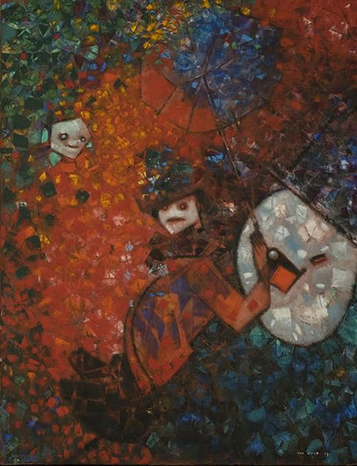
A further pictorial candidate came to my attention recently, in the shape of Max Ernst's Projet Pour Un Monument à WC Fields, a remarkable, kaleidoscopic painting of Mae West and WC Fields. In the centre of the 1957 work is a female figure, West, painted as a rotund, buxom torso in red, wearing an ornate hat and holding aloft an unfurled, multicoloured parasol. The right foreground features the head of a male figure, wearing a top hat and reaching out his hand. This is the comic actor WC Fields and the painting had apparently been inspired by the collaboration of Fields and West on a 1940 film called My Little Chickadee.